Monday, November 30, 2009

The Jimi Hendrix of Turntablism

DJ Qbert

Although I’m unsure where and when this phrase came about, it has been used to refer to DJ Qbert on a number of occasions. DJ Qbert was born on October 7, 1969 as Richard Quitevis. He is often hailed as one of the most influential DJs of all time. An innovative and creative individual, DJ Qbert paved the way in using turntables as an elaborate musical instrument. One of the most notable accomplishments of Qbert would be that he invited the first musical annotation system for scratching, battling, and composing on vinyl. The experiences and success of DJ Qbert have had substantial impact on Filipino-American hip-hop culture making it an integral part of hip hop culture as a whole.

Career
Like any legend, he started his career in humble surroundings. In the 1980s, hip-hop culture began to evolve giving rise to what is now known as the turntablist. At the age of 15, DJ Qbert became involved in DJing and went on to compete in small DJ battles in his San Francisco community. He was recognized in the world-wide since 1985 but truly dominated the DJ scene in the early 90’s. During this time, DJs such as DJ Qbert made skratching into an art form, inventing new techniques and developing unique sounds that revolutionized hip hop culture. In 1990 he began a group called FM20 with Mix Master Mike and DJ Apollo. While doing a show in New York he was invited to the Rock Steady Crew. From there, DJ Qbert went on to compete in the 1992 Disco Mix Club World DJ Championships (DMC). His most notable crew was the Invisibl Skratch Piklz which he helped founded. They were the first to apply the concept that included the layering of drums, basslines, and scratch solos on top of each other. He also produced two solos Demolition Pumpkin Squeeze Musik in 1994 and Wave Twisters in 1998. Two of his more recent and continuing ventures are the Thud Rumble LTD and Qbert Skratch University.

Thud Rumble LTD.Visit Site
An overview of Thud Rumble LTD. describes the company as a diversified media management company committed to showcasing and expanding the world of the skratch DJ. This company was founded by DJ Qbert and Yogafrog in 1996. Their dream was to push the “envelop of scratching as a science, an art, and an international culture.” It is said that this company is the key to transforming the world of Disc Jockey into a multibillion-dollar industry and is respected as one of the leading producers of independent works both in musical and other innovative processes.


Qbert Skratch UniversityVisit Site
This is a web-based video instruction site and community. Here you can pay $60 for 3 months. With this subscription you have access to a world-wide social network of DJs and receive DJ lessons from the renowned DJ Qbert himself.

DJ Qbert continues to play an active role in the DJ community today. As seen with his company, Thud Rumble LTd., and his online DJ Community, Qbert Skratch University. He has also influenced what is known as Pinay Hip Hop. Even today, the hip hop culture continues to flourish in Filipino and Filipino-American communities. With the growing international involvement, DJ Qbert is one of the role models Filipinos can look toward in this genre. His sites make it easier to gather knowledge and refine ones technique without any geographic barriers.

Other Trivia
Appeared in a number of documentaries and international films including:
Scratch
Battle Sounds
Hang the DJ
Modulations

Music Featured in video games Tony Hawk’s Underground and FreQuency

Awards
1991 Disco Mixing Club USA Champion
1992 Disco Mixing Club World Champion
1993 Disco Mixing Club World Champion
1994 Disco Mixing Club World Champion
1998 Disco Mixing Club DJ Hall of Fame award

-JP

Saturday, November 14, 2009

Pacquiao aka "The Greatness"

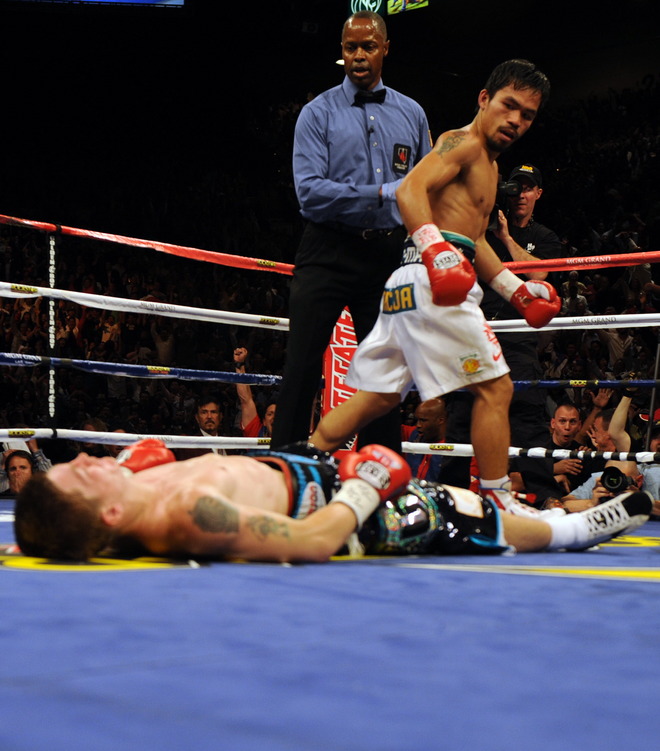
Emmanuel Dapidran Pacquiao, also known as Manny “Pac-man” Pacquiao, is a professional boxer. He is the first man to win seven world boxing titles in seven different weight divisions: flyweight, junior featherweight, featherweight, junior lightweight, lightweight, junior welterweight, and welterweight. This pound-for-pound king is also the only boxer to win the lineal championship in four different weight classes. Furthermore, after his fifth win, he became the only Filipino and Asian boxer to win those five world titles in five different weight classes. He was also first Filipino fighter to win a lightweight world title. While his accomplishments have made his name known world-wide, they have served a double purpose: Pacquaio has given Filipinos a hero.

(Photo courtesy of zimbio.com, by: Ethan Miller/Getty Images North America)

He is a talented fighter who set the bar for other Asian boxers; it is amazing to see how his fame has given millions of Filipino-Americans something to cheer about. However, it has also hindered progress in other aspects of his life. Although famous, his celebrity status seems to lay only in the ring. His movies flop, his political endeavors were frowned upon, and his interviews lie with smaller scale American talk-shows. Devoted Pacquaio fans wish for him to only pursue his sports career because it is obviously something he can do well. It is almost like a parent-son relationship, in which the parent pushes the child towards the goals already set for him because it is “what is best.” In this case, “what is best” seems to be influenced by the fact that it also gives the Philippines publicity throughout the boxing world. Pacquiao is easily one of the best in the sport. It is a way for a proud parent to say, “Look at what I have created. Look at my kid. He is the best, and everyone should know it.” He has become someone to brag about, a role model, a hero, a way for Filipino Americans to tie themselves to their culture.

To understand why he is so idolized, one must not only understand Pacquiao's history, but his people's history as well. The fact that the Philippines has been colonized twice is an important fact to understanding the Philippines' past and present. Because of Spain, who burned documents and erased almost everything before their arrival, most of what can be uncovered begins with the Spanish colonization. The American colonization occurs after, followed by the Japanese occupation. This is a story that begins with three hostile take-overs. In addition, the Filipinos were not only betrayed by outsiders but under President Marcos, they suffered a dictatorship as well. With all this corruption and violence, it is no wonder that Filipinos look up to Manny Pacquaio. Here is a man who literally fought his way to the top. And while there are many who see this as an irony and do not condone the sport, the drastic difference in the use of violence should be noted. Whereas Americans ordered their military to shoot anyone over 10 years old, Pacquaio fights for honor. His lineal championship shows that he is not the type of person to pick on the weak. With seven titles, and numerous other accomplishments, this renowned boxer does more than prove his own worth; as a representative of the Philippines, he shows the potential of the entire country.

After winning his seventh title, Pacquaio states that it will be his last weight division. He ends, “It's history for me; and more importantly, a Filipino did it.”

Accomplishments
  • Pacquiao was listed in Time Magazine as one of the world's most influential people for 2009
  • He was also in Forbes Magazine's Celebrity 100 list as the world's sixth highest-paid athlete
  • Pacquiao is the first Filipino athlete to appear on a postage stamp
  • With 1.25 million buys, the Pacquiao v. Cotto fight was the most watched boxing event of 2009
  • Pacquiao had also won the the title of Best Fighter in the 2009 ESPY Awards
  • He is featured in boxing video games, such as the Fight Night Round 2 – Fight Night Round 4 series

(Photo courtesy of philstar.com)


Unsuccessful Attempts

  • The film, Pacquiao:The Movie (2006), which was played by an actor, did not do well at the box office, grossing less than $100,000
  • He lost the election of becoming the representative of South Cotabato by 37,000 votes
  • Pacquiao tries to star in the action movie, Anak ng Kumander (2008), which does poorly
(Photo courtesy of pinoycentral.com)


Why We Still Love Him


Post by: A.C.B

(Photo courtesy of boxnews.com)

Thursday, March 27, 2008

Jabba-whaaat?


The JabbaWockeeZ are a dance group, known for winning MTV's America's Best Dance Crew: Season One. During their performances, they are known for wearing white masks and gloves, which makes audiences focus on the dancing and the teamwork involved. An important aspect of the masks is that a specific member cannot be targeted because of identical appearances. If one messes up, he can manage to blend in with the rest of the group. (Photo courtesy of hiphopstyler.com)

The group consists of ten members; five are Filipino, including: Rainen Paguio, Chris Gatdula, Phil Tayag. Randy Bernal, and Joe Larot. Although three out of the six performing on ABDC were Filipino, the team is known to be predominantly Filipino, and the name of the group was associated as such. In a sense, the popular show gave Filipinos exposure throughout all of the United States. Media has played a huge part in this, influencing Filipino Americans by exposing talented people of their culture. Although Filipinos are the second largest Asian community in the United States and have been dancing for years, it is interesting to see how much publicity needed to be generated in order to gain the nation's attention. This particular dance crew reached millions of viewers, who turned into millions of fans, wearing shirts proudly displaying their name. The JabbaWockeeZ were special because although they didn't exactly begin a dance movement, their publicity now influences our generation of Filipino Americans who are gaining more respect as dancers – ironic, considering their past.

Historically, Filipinos came to America and had to work low-paying jobs. They experienced a lot of racism, and were stereotyped to be wild and barbaric. A characteristic that helped attribute to this was their affinity for dancing. Beginning in the 1920s until the early 1930s, Filipino men frequented areas called taxi dance-halls. These men came to pay and dance with women as a way to relieve stress and let loose after a hard day's work. These halls were present mostly in the city, where Filipinos migrated for job opportunities. At these popular American institutions, nearly a quarter of its attendees were Filipinos. It was a form of socialization for the immigrants, who were usually denied entry into other areas. Filipinos would purchase dance tickets, select a woman within the group of taxi dancers, and dance with her to a live band. Dancing was a form of relaxation, and Filipinos were good at it. However, their dancing skills drew attention from both taxi dancers and other patrons – particularly white males. This talent threatened them, who began fights out of jealousy. They claimed the dancing was lewd, even sexual. However, it was actually the women who were aggressive; they were highly attracted to these polite, talented dancers. After a while, too much violence erupted, and many dance-halls began to turn Filipinos away. This was a double blow; not only did they lose a popular source of socialization, but it was due to envy over their ability to dance well. White Americans could not stand the idea that these poor, immigrant workers could possibly excel at anything, much less a harmless recreational activity.

The interest in dancing may have started when the Filipino immigrants began to assimilate to the westernized world, focusing on popular culture. Or it may have evolved from a gene, rooted from the Tribal dances of their ancestors. Or perhaps because the Filipino society embraces dancing, children were taught at a young age. Regardless, there is one thing for certain: whether it is a Filipino's love of dancing, singing, emceeing, or deejaying, their musical talents thrive. Today, dancing is a talent that is appreciated throughout the country. It is seen as beautiful and artistic. Numerous colleges focus on dance, and most high schools have programs available for students who wish to learn it. There are careers as dance teachers, as well as dancers in different genres. Specifically, many Filipinos are known for their talent in hip-hop dancing. This became known to the general public when the group, JabbaWockeeZ, became the first winner of MTV's ABDC. With a prize of $100,000 and massive amounts of publicity, they won their well-deserved fame. JabbaWockeeZ showcased their unbelievable talent, and were brought to the top by American voters and judges. It was not just Filipino-Americans who stood in awe, but the majority of whoever followed the show and decided to show support. This team does more than symbolize the Filipinos' assimilation into the American culture, and does more than display Filipino ability; it is a progressive step in which America gives Filipinos respect, and applauds them for their success.

Appearances in America

  • Appeared in a Pepsi and Gatorade commercial
  • Guest Performance on The Ellen DeGeneres Show
  • Guest Performance on Live with Regis and Kelly
  • Cameo in the movie Step Up 2: The Streets
  • Launched clothing line
  • Performed at the University of Florida's "Gator Growl"
(Photo courtesy of deviantart.com)

Appearances in the Philippines

  • Balitang America appearance on The Filipino Channel (TFC)
  • Appeared on Adobo Nation on TFC
  • Guest performance on Wowowee
Post by: A.C.B


Friday, February 2, 2007

Monique Lhuillier


Born in 1971 in Cebu City, Philippines, Monique Lhuillier is a Filipina Fashion designer based in the United States. She was born to Michel Lhuillier and Amparito Llamas, a Filipina society figure and former model of Spanish-Cebuana descent. Their family owns a popular chain of pawnshop in more than a hundred cities in the Philippines.

It was her mother’s glamorous sense of style and the constant travelling around the world that sparked interest in her pursuing a career in fashion. She was an outstanding student in Switzerland and hoped to excel in the fashion industry so her parents sent her to the FIDM and met her future husband, Tom Bugbee. They opened their own company in 1996 and launched their first briday collection which was well received by fashion-savvy brides, editors, and celebrities.

When Monique finally graduated and looked for a job, she realized that there were not so much quality couture companies in the LA metro. Unwilling to leave for New York, Monique took a design position at a French company that specialized in better evening wear separates.

Shortly after her engagement, Monique decided to take some time off and plan the wedding. During her dress search, her focus on the wedding business was reborn. She was determined to be part of it and make it better.

The breakthrough came after Monique designed the gowns for her wedding entourage. These captured the fancy of couture circles. Having had a difficult time finding her own gown, Monique, 23 at that time, decided to begin sketching her own line of dresses. And it was then when her husband figured it was more than just a hobby.

Making a name for herself, Monique had designed gowns for celebrities like Sarah Gore, Heidi Montag, and Britney Spears. One of her gowns was worn by Hilary Duff in A Cinderella Story.


Monique received the 2001 Glamorous bridal designer award, the 2002 Avant Garde bridal designer award, and the 2003 designer of the year award from wedding dresses magazine and the bridal industry members. In 2003 she was also inducted as a new member of the Council of Fashion Designers in America.

Subsequently, Monique added evening wear to her line, and several of her efforts showed up on red carpets before awards shows. For the fall 2007 season she branched off into more typical runway collections.

On February 2nd of the 2007 Fashion Week Spring Collection at the New York fashion week, she introduced mostly sophisticated and fluid looks.

-CA

Thursday, September 28, 2006

Alec Mapa and the LGBT Movement

Alec Mapa is an openly gay Filipino American actor, comedian, and writer. He has recurring roles in “Desperate Housewives” and “Ugly Betty” where the characters he plays are flamboyantly homosexual. Mapa has been recognized by the LGBT community as an outspoken promoter of equal rights. His identity as a gay Filipino American is significant in this regard: large parts of the Filipino community are anti-gay rights according to their religious dogmas, and for Mapa to stand up as the gay Filipino American posterchild really enables the gay Filipino minority to be comfortable with their identities.


Alec Mapa, gay Filipino American actor

The LGBT equal rights movement has really been picking up in recent years, and Mapa's visibility on national television lends to society's perception of LGBT community as a normal part of everyday life (which it is, but isn't perceived as). Though gay rights have suffered in the past couple years' elections, Mapa's and others' dedication to the cause has not wavered. Beyond just representing the LGBT community on television, Mapa participates in fund raising events to raise money for equal rights.


Mapa with cast members of "Ugly Betty"

Part of the growth of the LGBT movement is due to national exposure of a wide spectrum of sexual identities. However, playing a flamboyantly gay character is extremely challenging to do because the character potentially can scare off the audience. It's one thing for the audience to find out that a character is gay and be comfortable with it, but another thing entirely to know from first glance that a character is gay and be comfortable with it. Mapa has a very good way of representing the flamboyant lifestyle while making the characters palatable to a potentially anti-gay audience. In this respect, Mapa can lend support to gay Filipino American and Asian Americans who are coming to terms with their identities. Also, he helps society identify with having the LGBT community as an integral part of society.


Mapa on set of "Desperate Housewives" with Eva Longoria

As a gay Filipino American playing gay characters on national television, Alec Mapa has lent considerable support to the LGBT community. He and other actors and actresses have been doing their part to bring awareness of the LGBT community and cultural acceptance and equal rights for all. Mapa's role in bringing awareness has been particularly helpful in the Asian American community, where being openly gay can be very hard to do and be supported due to the anti-gay posturing of the culture as a whole. Hopefully, with time, Mapa's efforts will shine through and the LGBT community will gain the equal rights and cultural acceptance they deserve.


Mapa at the GLAAD (Gay & Lesbian Alliance Against Defamation) Awards with Kate Walsh


-RZ

Wednesday, August 30, 2006

Apl. De. Ap.'s BEBOT


Apl. De. Ap.’s song “Bebot” from the 2005 Black Eyed Peas album Monkey Business sparked controversy for this two music videos. Pat Ginelsa, the director of “The Apl Song” and the award winning film “The Debut”, directed and shot Bebot “Generation One” and “Generation Two”.

The first of these two music videos, “Generation One”, pays tribute to the history of the Filipino American male worker. Set in Stockton, which is often noted as an important site for Filipino “bachelor communities”, the music video follows Apl as a agricultural laborer leaving the fields after a lone day and then going to a Taxi Dancehall. It is in this space that the bulk of the video takes place.

Personally, I like this video a lot more on several levels. First, I feel like the video is far more aesthetically pleasing and more in line with Pat Ginelsa’s work. Secondly, I really enjoy the way that Apl. De. Ap., Pat Ginelsa, and the rest of the Black Eyed Peas (though their roles in this music video are to be like Fergie in every video) offer an alternative history lesson using their popularity. Finally, I like this video more because it’s not filled with fleshy gyrating female bodies, but shows both men and women dancing in pleasure. Also, I like their red lipstick!

I feel like “Generation One” of the “Bebot” music videos also stays more true to way that the Black Eyed Peas reached high commercial success. Well, it stays more true to their roots. I guess “Generation Two” can be summed up as the entry of Fergilicious. Apl. De. Ap. and Will. I. Am. (in both their oldly named glory) started a B-Boy dance crew called Tribal Nation in the 90’s. They performed around Southern California. DJ Icey Ice, when he came to talk about Filipin@s in Hip Hop, talked about how the early stages of the Black Eyed Peas would perform at his parties. I feel like “Generation One” is more authentic.

On the other hand, “Generation Two” is the pop culture new and less true performative version. I feel like even though it is the exact same song playing, the music video destroys the vibe of the song and distorts it into another music video that I could pass on. I have several issues with this music video. The role of Apl’s mother, or maybe even the “thick accented Aunt”, plays on a stereotype of the Filipina American, which is often also documented in Pilipino Culture Nights. Secondly, the video revolves around the performing female body. It’s difficult to believe that the music video is not “objectifying women” as the notes before the video state. Finally, I just don’t like the bright colors as much. I feel like they are distracting and borderline irritating.

I’m not making the stance that music videos cannot be contemporary, but rather that “Generation Two” leaves me feeling a bit disappointed. I wonder whether progressive artists that I know, who work the activist networks, would be just as willing to sacrifice the integrity of their history to make a video that would receive more airtime. Whether their popularity must come at the expense of women?

Apl.de.ap still does great work for the Filipin@ and Filipin@ American community. He started the Apl Foundation, which gives back to communities and children within the Philippines and throughout Asia. He also started his own music company called Jeepney Music, Inc., handling DJs such as Free School, DJ Rockyrock, DJ MIA, and PoetNameLife.


-GY

Saturday, August 23, 2003

Dual Citizenship – Reclaiming the Filipino identity

Citizenship Retention and Re-acquisition Act of 2003
On August 29, 2003, the government of the Philippines passed Republic Act No. 9225 also known as the Citizenship Retention and Re-acquisition Act of 2003. This law allows natural-born Filipinos the opportunity to retain or re-aquire their Filipino citizenship in addition to the citizenship of their resident country. Essentially, dual citizenship already existed due to operation of nationality laws. For instance, a child born in the United States to Filipino parents is considered an American citizen according to jus soli, place of birth, and a Philippine citizen by jus sanguinis, citizenship of parents. However, citizenship in the past has been lost due to naturalization in another country.

After the passage of R.A. 9225, citizenship is no longer lost upon naturalization as the natural-born Filipino retain citizenship. In addition, natural-born Filipinos can re-acquire their lost citizenship through an application process. Residency is not a requirement for application as there are methods of applying while overseas in addition to within the Philippines.

Implications for Filipino-Americans
If a Filipino-American qualifies as a natural-born Filipino, they can apply to dual citizenship and regain full civil, economic, and political rights under existing laws of the Philippines. This includes but is not limited to the right to own property in the Philippines, right to acquire a Philippine passport, and right to vote in elections. Other citizenship duties such as income tax are only applied to income earned from the Philippines. A professional can also apply for licenses or permits to engage in their legal practice.

By having dual citizenship, Filipino-Americans are gaining a number of advantages. For instance, some Filipino-Americans wish to stay in the Philippines for extended periods of time. However, extending tourist visas can become extremely expensive and restrict the period of time a person can stay in the Philippines. By becoming a citizen, a person can automatically be allowed to stay for a year. This act also allows many to retire to the Philippines after spending a majority of their adult life in the United States. There are limitations of how much land a foreigner can purchase or invest in and citizenship removes these. There are also those that wish to become “Filipino” again and this allows them to do so. In a sense, it allows them to finally return home.

Requirements for applying for retention or re-acquisition of Filipino citizenship
As according to the Commission on Filipinos Overseas
Duly completed verified petition
Notarized Oath of Allegiance
    "I, ________________, solemnly swear that I will support and defend the Constitution of the Republic of the Philippines and obey the laws and local orders promulgated by the duly constituted authorities of the Philippines, and I hereby declare that I recognise and accept the supreme authority of the Philippines and will maintain true faith and allegiance thereto, and that I impose this obligation upon myself voluntarily without mental reservation or purpose of evasion."
Two (2) recent 2”x2” colored photographs of applicant
Application Fee (US$50 for overseas applicants or PhP 2,500 for Philippine based applicants)
Proof as natural born Filipino citizen, an original or photocopy of at least one of the following:
    a. Philippine birth certificate
    b. old Philippine passport
    c. voter’s affidavit or voter’s identification card
    d. marriage contract
    e. other documents proving that the applicant is a former natural born Filipino citizen
photocopy of foreign passport
photocopy of certificate of naturalization or an original affidavit stating how foreign citizenship was acquired
two self-addressed and stamped legal size envelopes

Summary of process


Sites to visit
www.ecensus.com.ph - Birth certificates can be requested through the NSO website
www.immigration.gov.ph - R.A. 9226 Form No. 1 can be downloaded from here
www.dfa.gov.ph - contact information and addresses for Philippine Embassies and Consulates where applications can be filed

Monday, May 21, 2001

EDSA 3


EDSA 3 was a protest sparked by the arrest in April 2001 of newly deposed Erap. The event still took place in EDSA. 4 months after EDSA 2, the protests were asserted as a more populist and representative uprising compared to the previous demonstrations. The protests and the attack of the presidential palace failed in their objectives. Participants continue to claim that it was a genuine People Power event, a claim disputed by the participants and supporters of Edsa 2. President GMA has acknowledged the diversive nature of the two terminologies by saying in one statement that she hoped to be the president of the Edsa 2 and Edsa 3.


The crowd of an alleged several thousand Filipino people , most of whom were urban poor and devotees of Iglesia in Cristo, gathered at the Edsa Shrine. News organizations aiming to cover the rally were advised to to approach EDSa as there were reports of stones being thrown at cameramen, especially those from ABS-CBN. This protest, however, was led by members of the political opposition of the time: Enrile, Defensor-Santiago, and Sotto III.

The rebellion aimed to remove GMA from presidency and to reinstate Estrada. It was in May 1, 2001, when the rebellion came to a head on the morning of that day. Hundreds of thousands of protesters stormed towards Malacanang Palace. Several broadcast vans of media personnel were attacked by the crowd, the dispersed marchers, causing violence causing the police and military personnel to implement maximum tolerance policy.

Hours after the crowds of Edsa2 were dispersed, representatives of the Archdiocese of Manila and Civil Society supporters of the Arroyo administration reclaimed the Edsa Shrine where there had been alleged acts of vandalism and garbage all over the vicinity. Since the protest was carried out mostly by the lower income, uneducated masses, widespread destruction and vandalism of public utilities and public store fronts along the protest routes at Recto Avenue.


Critics of Edsa 3 argue that while this was major protest, the spirit of it was unlike the first and second protests. Supporters of Edsa 3 journalism allege that Edsa 1 and 2’s participants were made up of the middle and upper classes and thus, not democratically-representative unlike the participants of Edsa 3. Other arguments also point to the success of the first two to remove the presidents targeted, as opposed to the Edsa 3’s failed event.

-CA

Monday, May 14, 2001

EDSA DOS


EDSA DOS, also known as the Edsa Revolution of 2001, is the common name of the four day popular revolution that peacefully overthrew the then President, Joseph “ERAP” Estrada, which took place in January 17-20 2001.

It was in October 2000 when Chavit Singson, Ilocos Sur Governor, went public with accusations that Estrada and his friends and cronies received millions of pesos from operations of the illegal numbers game called jueteng. And this prompted rage from the public.

The next day, Senate Minority Leader Teofisto Guingona Jr. delivered a fiery privilege speech accusing Estrada of receiving P220M in jueteng money from Singson from November 1998-August 2000, besides taking P70M on excise tax on cigarettes for Ilocos Sur. The privilege speech was referred by Senate President Franklin Drilon, to the Blue Ribbon Committee and the Committee on Justice for joint investigation. Another committee in the House of Representatives decided to investigate the expose, while other house members spearheaded a move to impeach the president.


On January 17, 2001, the impeachment trial of President Estrada moved to the investigation of an envelope with an evidence that would prove acts of political corruption by Estrada. Senators allied with Estrada voted to block the evidence and after the vote took place, with not opening the envelope favored, Aquilino Pimentel resigned as Senate President and walked out, followed by the 9 opposition senators.

The walk out and the voting outcome prompted the Philippine National Police and the Armed Forces of the Philippines to withdraw support for Estrada, joining the crowds at the Edsa Shrine 2 days later. At 2 pm that day, Estrada appeared on television the first time stating that he will not resign, rather, he wants the impeachment trial to continue, stressing that only a guilty verdict will prompt him to resign from his office.


Shortly after, Erap called for a snap presidential election to be held with congressional and local election on May 14, 2001. GMA then takes her oath of office in the presence of the crowd at EDSA, becoming the 14th woman president of the Philippines. At 2pm , Erap released a letter saying he had strong and serious doubts of the legality of her presidency, but said he would give up his office to avoid being an obstacle to healing the nation. Later, Erap finally conceded and his family leave Malacanang Palace, and was placed on house arrest.

-CA

Friday, March 16, 2001

The Debut


The Debut (2001) is the first Filipino-American film to be released in theaters nationwide. It serves as an example of contemporary life for second generation Filipinos, with themes pertaining to identity, acculturation, and family. This movie is especially catered to Filipino Americans because of the story line. It is the typical question that all Filipino Americans must answer: with whom do I identify? For most, a lack of exposure may lead to disinterest in one's cultural heritage. Vernacularly speaking, Ben's character would be called “white-washed,” meaning that he has assimilated to America so well that he is devoid of any customs, knowledge, or even curiosity about the Philippines or Filipino life. Ben also criticizes others for having an accent, even though they have lived for years in the United States.
“It wouldn't be pair.” (In a filipino accent, f's sound like p's.
He's saying “fair.”)

“What?”
“I said it wouldn't be pair to jump in.”
“Man, what does fruit got to do with this? I can't believe I'm related to you. You've been here two years and it still looks like you went through customs yesterday.”
In some ways, it is not Ben's fault. Although there are many Filipinos in America, their influence at the time was weak, in regards to public appearance either in politics or popular culture. The history of the Philippines is also limited in schools. Because the American colonization was a gruesome one, it tends to be skimmed, just listing figures like General MacArthur, who saved the Philippines from the Japanese occupation. It does not delve into the Battle of Manila, the creation of concentration camps, or events such as the World's Fair. This re-education of the Filipinos began shortly after their colonization. There is a common saying that the winners get to write history. In this case, it is partly true because the Filipino school systems were under the control of the Americans. Educators would glaze over the bloody history, and focus on the United States as saviors. So where is one to learn about the Philippine's true history? Unless enrolled in a Filipino/American Experience class, or through personal endeavors, one is forced to seek it from friends and family. For example, parents can tell stories about their past, and friends can collect a group and attend a Pilipino Culture Night. Otherwise, that person is at a loss. A culture should be immersing; if areas lack anything remotely Filipino, interest isn't even generated. The Debut was groundbreaking because it was the first Filipino American film to really gain attention in the United States. It's modern twist helps relate it to the current generation, which in turn helps them identify with it. Old history films sharing, say, information about the World's Fair, seem like so long ago that it hardly seems identifiable. This also goes for current Filipino soap operas who may have less of an impact due to its ridiculous story plots.

Because of acculturation, history becomes more diluted with every generation. It's important to reinstate the value of culture, and to target those who will be able to pass it on to their children. This movie is specifically for Filipino-Americans because it tells their story in hopes of reaching out to those torn between the two cultures. It emphasizes the importance of family, culture, and tradition – things Filipinos are proud of. Ben learned that he should never be ashamed of where he comes from. The Debut teaches audiences to celebrate the Filipino American experience, because in the end, it is a part of who they are.

Plot synopsis:
Ben is a talented high-school senior who dreams of going to an art school after graduation. However, his strict father wants him to become a doctor and accept a scholarship to medical school instead. His demand is fueled by good intentions – as an immigrant coming to America, he only wishes the best for his son, and wants him to have a stable career with a high paying job. He doesn't wish to hear of Ben's dreams, and this conflict of interests leads to many arguments between them. There is also a cultural difference: whereas the rest of the family still adheres to Filipino customs and traditions, Ben has rejected his Philippine heritage. Everything begins to pique as his sister's 18th birthday is arriving, and they are preparing for her debut. A debut is a woman's coming-of-age party, in which she is officially presented to society. There is also a court in which the young men and woman dance. Ben would rather hang out with his Caucasian friends than attend, but he is finally pressured to go. It is at her debut that he finally confronts all his problems. Things begin to change as events unfold and he forced to question himself, the choices he has made, and the way in which he sees the world. He begins talking to his sister's best friend Annabelle, who gives him a listening ear. Unfortunately, her ex-boyfriend appears, and he begins a fight. He calls Ben names like “white boy” and “coconut,” meaning that he is brown on the outside but white on the inside. In the end, the culture clashes make him realize that his Filipino heritage is important, and he resolves things between him and his father.

Awards

2000 Audience Award for Best Feature Film – Hawaii International Film Festival

International Film Festival 2000 Best Feature Film – San Diego Asian Film Festival


All pictures: (Photo courtesy of debutfilm.pinoynet.com)


Post by: A.C.B


Tuesday, June 30, 1998

Joseph Estrada


Was it the time? Are the Philippines that susceptible to the glamour of Hollywood and the film industry in the Philippine? Joseph Estrada, the 13th president of the Philippines, seems to share several key notes with the former first lady Imelda Marcos.

On June 30, 1998, Joseph Estrada was sworn in as president of the Philippines. He won with a wide margin of votes in his favor. Joseph Estrada gained popularity, leading to widespread support with his entrance into politics, by first being a famous movie actor. The margin of victory in this free election is the largest in the history of the Philippines.

Joseph Marcelo Ejercito was born on April 19, 1937 in Tondo, the poorest part of Manila. His father, Emilio Ejercito, was a government engineer, setting his family upper middle class. Joseph Estrada attended the Mapua Institute of Technology in hopes of following in his fathers footsteps, but eventually dropped out to become an actor. His family forbad him from using the family name, so he picked up the name Erap Estrada. Joseph Estrada played over one hundred lead roles, usually portraying the tough valiant guy who defended the poor against corrupt establishments.


In 1968, Joseph Estrada entered politics by running for mayor of San Juan. In 1968 he lost his bid for mayor but by 1969, after he won an electoral protest, he became the mayor. As mayor, Joseph Estrada built schools, parks, and a modern police station. While his contributions to building monuments to testify his legacy as the mayor of San Juan, I question whether he was inspired by the Edifice Complex that plagued Imelda Marcos.

In 1975, Joseph Estrada co-founded, with Dr. Guillermo De Vega, the first Metro Manila Film Festival. This was the same festival that is linked to stories of a collapsed building, ghosts, and Imelda Marcos’s decree to continue building.

In 1992, Joseph Estrada meant to run for president, but decided to join Eduardo Cojuangco Jr. and run as the Vice President. Cojuangco Jr. lost the election for presidency, but Joseph Estrada won the vice-presidency. Estrada was appointed head of the Presidential Anti-Crime Commission.

During Joseph Estrada’s run for presidency, the Roman Catholic Church refused the support Joseph Estrada because he had admitted to having fathered four children by women other than his wife. However, Imelda Marcos, then a member of Congress, gave him her support. He also had a devoted following among the country's poor, who often associated his image to the roles that he played.

While I documented the major moments of Estrada’s political achievements, his legacy is littered with corruption and embarrassment. In looking through Joseph Estrada’s biography, political timeline, and major moves, it is difficult to type cast him. Initially, I saw Joseph Estrada sharing many parallels to Imelda Marcos. However, the main distinction is the financial crisis in Asian in 1998. As president, he seemed to have strong understanding of the economy and a better grasp of the needs of the people that Imelda ever did.

In my opinion, the Philippines suffer most from the mental colonization imposed my the United States. Although I am part of the community directly, the vibe of the Philippines that classmates give is that the Philippines is heavily influenced by American pop culture. While there is the beginnings of a rise in nationalist pop culture, for the most part the airwaves and silver screen are dominated by Amerika still. This kind of history of devotion leads people to sway their political leanings with those that they are familiar with-- allowing many different pop culture icons to enter politics.

After thought: In May 2009, Senator Jinggoy Estrada, the son of former Philippine superstar, ex-president and convicted plunderer Joseph Estrada, delivered a speech to the Senate, asking that the management of the Metro Manila Film Festival be given to the Philippine film industry itself.


-GY

Friday, December 2, 1994

Benjamin Cayetano, First Filipino American Governor

On December 2, 1994, Benjamin Cayetano was elected for Governor of Hawaii, and was the first Filipino-American to serve as a state governor in the United States. He left office in 2002, but during his service as governor, he spear-headed a number of sweeping social reforms. He instituted tax cuts, championed school reform, and signed the first legalization of medicinal marijuana in the United States, a topic that is still controversial today, 8 years after the fact. However, perhaps more intriguing than his great accomplishments are his humble beginnings.


Cayetano advocated after school programs, medicinal marijuana, and economic stimulus, but probably not all at once

Cayetano was described as a “latchkey kid” and didn't attend college after graduating high school in 1958. As a young father, he instead worked in a series of menial labor jobs to support his family. Upon being subjected to hiring practices he viewed as racially motivated and politically unfair, Cayetano decided to do something about it. He moved his family to Los Angeles in 1963, where he attended UCLA and eventually earned a law degree in 1971. In 1974 he was elected to the House of Representatives to hold the seat for Honolulu. In 1986 Cayetano became lieutenant governor of Hawaii, and in 1994 he was elected governor.


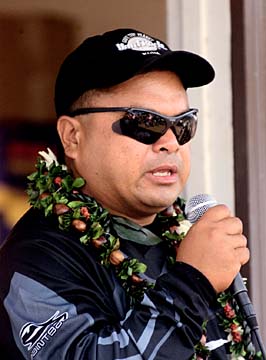
Benjamin Cayetano, delivering a speech, wearing leis

Benjamin Cayetano's climb to power is significant for the Filipino American community. His feat certainly makes holding a government office within reach for any aspiring Filipino American youths. It's not so far fetched to say that even the Office of President is within reach for Filipino Americans. (Especially so now that our current president is a member of a minority.) Cayetano's story makes it clear that it is possible to make a difference in society, even those from a poor background can rise up and take a stand. In fact, the school reform introduced by Cayetano was inspired by the hardships he faced in childhood. State funded after school programs would give students a place to be motivated and feel belonged.


Brandon, the son Benjamin worked to
support after high school, also in lei atire

Notably, Cayetano's beginnings are very relatable to many people both in the Filipino American community and outside. Working hard to support a new family with limited income is a daunting task, yet it is a situation that a lot of people find themselves in. Now, not everybody is going to become the governor of Hawaii, but Cayetano's story shows that there is more to be had and earned beyond working a dead-end job countless hours a week. So while Cayetano made significant headway for Filipino Americans by becoming the United States' first Filipino American governor, perhaps the inspiration he gives stems more from his humble beginnings than his great accomplishments.


Cayetano has written a memoir about his rise to power

-RZ

Monday, August 8, 1994

Kapamilya mo, Saan man sa mundo: Your Family, Worldwide

ABS CBN International: In The Service of The Filipino Worldwide

Alto Broadcasting System-Chronicle Broadcasting Network (ABS-CBN) is a multi-media conglomerate based on the Philippines. In 1994, ABS-CBN took their network to the international level and launched The Filipino Channel (TFC) on the West Coast in the United States. Shortly after launch, TFC became available nationwide and became the first and most successful Filipino broadcaster. Since then, it has become available in a number of countries world-wide with over 2 million subscribers. In the US there are 200,000 Filipino and Filipino-American subscribers alone.

The Filipino Channel has played a pivotal role in the Filipino community. There is probably not a single Filipino-American family that does not know about TFC. It continually provides one of the few places Filipino-American children can see role models of Filipino descent. ABS-CBN prides itself in being able to help second-generation and third-generation Filipino-Americans feel closer to the culture. The programs on The Filipino Channel include a variety of genres including comedies, dramas, reality shows and movies. It also provides a direct link to current events and news happening in the Philippines. One show, Citizen Pinoy, deals with issues regarding immigration and addresses various problems that might arise during immigration and settlement into the American lifestyle. Talk shows such as The Buzz keep Filipino-Americans up to date on the latest gossip regarding Filipino and Filipino-American celebrities. Balitang America was the first-ever Filipino American news program to be broadcast in the United States. Similar to other network news station, the stories reported on Balitang America feature community features, profiles, special reports, and international news.

TFC has developed its own shows that showcase and promote various Filipinos and Filipino-Americans world-wide. Wowowee is probably considered one of the most popular shows on The Filipino Channel. It is a variety show that often features Filipino and Filipino-American celebrities. It is normally filmed in the Philippines but has gone on tours in the past. This year, Wowowee went on a world-wide tour to celebrate its 4th anniversary. The show itself is comprised of a variety of segments. One is Hep,Hep, Hooray and involves 10 randomly chosen audience members. The audience dances to “Boom Tarat Tarat” while the 10 are chosen. The game itself requires coordination and rhythm with the last person standing becoming the winner. The participants then go on to play in several other segments. Some of the celebrity performances from the United States that have appeared on Wowowee have been the Jabbawockeez and Apl De Ap of the Black Eye Peas. The Philippines has also developed its own reality shows based on American shows such as The Spelling Bee and Pinoy Big Brother.

The services provided by ABS-CBN have expanded into other areas and includes many interactive venues. For instance, ABS-CBN now provides Filipino on Demand. This newest service is a video on demand subscription that gives access to award-winning classics, blockbusters, miniseries, and live concerts 24/7. TFC Studio Tours provides TFC subscribers with the chance to visit the studios and sit in on the shows. In addition, this is available world-wide depending on show availability. A number of the shows involve participation of Filipinos world-wide and aids in bridging the gap between the various countries Filipinos currently reside in.

-JP

Saturday, September 25, 1993

The Trials of Imelda Marcos

In 1993, Imelda Marcos, Former First Lady of the Philippines and widow of the controversial Ferdinand Marcos, was convicted of corruption on two charges by the Sandiganbayan (the anti-corruption court in the Philippines) and was sentenced to 18 years in prison and was barred from running for public office ever again. In total, more than 90 criminal and civil cases were brought against the Marcoses, with allegations that they stole more than $5 billion from the economy for themselves and even more for their associates.


Imelda being convicted

The Supreme Court would later overturn Marcos' prison sentence, ruling against the Sandiganbayan and accusing the Judge of having bias against Marcos. As of 2008, Mrs. Marcos still had 10 pending criminal cases. Over the years she has been able to use her political power to delay and overturn the cases brought against her and her husband. She has been able to avoid prison sentences, though the courts have seized some of her bank accounts.


Clip from the documentary, IMELDA, featuring a portion of her trials

How has this impacted Filipinos at home and abroad? The name Marcos is now equivalent to corruption in the Philippines as Nixon is in the United States, however on a much greater scale. Whereas Nixon only had one scandal tied to his name (Watergate), the Marcos have an entire era of martial law tied to theirs, during which they padded their pockets and led very lavish lives. However, unlike Nixon, who was pardoned by Ford, the Marcoses were exiled, and Imelda was charged for graft and corruption upon repatriating.

These trials are more symbolic than anything. They are a sign that Filipinos will stand up to corrupt politicians. At this point, I don't think it really matters if Imelda is convicted or not, as a practical matter. Would justice be served if she were to be convicted? Surely. Is it necessary? Probably not. The damage has already been done. Her name is already tarnished, and the history books will bear record of that. It doesn't really make sense to imprison her now; because of her age, any sentence would be equivalent to a life sentence, and is highly unlikely to happen because of that anyway. This is worth noting: although they won't sentence her now, they still won't overturn the remaining cases against her, because if anything, the show of the trials are symbolic of the Philippines' stand against government corruption.


This old lady wouldn't last a day in prison...

However, these trials may only be that: merely symbolic. There is still corruption in the Philippine government. Most notably, the current president, Gloria Arroyo, is accused by many of being corrupt. If Imelda's trials go on but not even a passing glance is pointed towards President Arroyo, then the trials won't mean anything but to pacify any dissenters while the nation's current politicians go on to exploit the country.


President Gloria Arroyo is believed by many to be corrupt

-RZ

Monday, July 16, 1990

1990 Luzon Earthquake


The late afternoon in Luzon was shattered by a 7.8 earthquake on Monday, July 16, 1990. Luzon, known for its dense population reported distinctly high deaths—numbering around 1,621 people. The 1990 Luzon earthquake is now known as one of the deadliest and consequently most expensive natural disasters to ever hit the Philippines.

About 20,000 square kilometers was damaged by this earthquake stretching from northwest of Manilla through Central Luzon and into the mountains of the Cordillera Administrative Region.

One of the hardest hit places was Baguio City. A popular tourist destination in the Philippines, many private and public building were damaged or destroyed. Many of these building were hotels. The most notable was the five-star Hyatt Hotel. A twelve story section above the lobby area collapsed, killing about fifty people.

Many of the people affected by the earthquakes, whether the Philippines was the place they were visiting or even worse, their homes were destroyed, set up tent in public parks, like Burnham Park, or in the streets. A major route from Manila is Baguio city, Kennon Road, was shut down by all the people living there.


Because of the placement of the city, it was impossible to send aid for the first forty eight hours. Water, communication, and electric lines were destroyed. Only by helicopter was aid able to get to the city, because it was surrounded by vicious landslides. The airport was demolished.

Hospitals crumbled literally and figuratively. The building could not be used and there were thousands of hurt people waiting to for medical attention. Hospitals set up tents. Baguio City became a tent city.

In the midst of this disaster, there were some miracles. Out of the Hyatt Terrace Hotel, two people came out alive days after the quake. Luisa Mallorca and Arnel Calabia were extricated from the rubble 11 days after the quake, while hotel cook Pedrito Dy was recovered alive 14 days following the earthquake. All three survived in part by drinking their own urine and in Dy's case, rainwater. Dy's 14-day ordeal was cited as a world record for entombment underneath rubble.

Because Baguio is home to a large mining company and a military academy, experienced miners and other disciplined volunteers played a crucial role in early rescue efforts. Rescue teams arriving from Manila and elsewhere in Luzon were able to decrease mortality from major injuries. Surgeons, anesthesiologists, and specialized equipment and supplies were brought to the area, and victims were promptly treated. Patients requiring specialized care (e.g., hemodialysis) not available in the disaster area were airlifted to tertiary hospitals in metropolitan Manila.

When we think of the recent Earthquake Ondoy, it is difficult to not remember what happened nineteen years ago.


-GY