Tuesday, June 30, 1998

Joseph Estrada


Was it the time? Are the Philippines that susceptible to the glamour of Hollywood and the film industry in the Philippine? Joseph Estrada, the 13th president of the Philippines, seems to share several key notes with the former first lady Imelda Marcos.

On June 30, 1998, Joseph Estrada was sworn in as president of the Philippines. He won with a wide margin of votes in his favor. Joseph Estrada gained popularity, leading to widespread support with his entrance into politics, by first being a famous movie actor. The margin of victory in this free election is the largest in the history of the Philippines.

Joseph Marcelo Ejercito was born on April 19, 1937 in Tondo, the poorest part of Manila. His father, Emilio Ejercito, was a government engineer, setting his family upper middle class. Joseph Estrada attended the Mapua Institute of Technology in hopes of following in his fathers footsteps, but eventually dropped out to become an actor. His family forbad him from using the family name, so he picked up the name Erap Estrada. Joseph Estrada played over one hundred lead roles, usually portraying the tough valiant guy who defended the poor against corrupt establishments.


In 1968, Joseph Estrada entered politics by running for mayor of San Juan. In 1968 he lost his bid for mayor but by 1969, after he won an electoral protest, he became the mayor. As mayor, Joseph Estrada built schools, parks, and a modern police station. While his contributions to building monuments to testify his legacy as the mayor of San Juan, I question whether he was inspired by the Edifice Complex that plagued Imelda Marcos.

In 1975, Joseph Estrada co-founded, with Dr. Guillermo De Vega, the first Metro Manila Film Festival. This was the same festival that is linked to stories of a collapsed building, ghosts, and Imelda Marcos’s decree to continue building.

In 1992, Joseph Estrada meant to run for president, but decided to join Eduardo Cojuangco Jr. and run as the Vice President. Cojuangco Jr. lost the election for presidency, but Joseph Estrada won the vice-presidency. Estrada was appointed head of the Presidential Anti-Crime Commission.

During Joseph Estrada’s run for presidency, the Roman Catholic Church refused the support Joseph Estrada because he had admitted to having fathered four children by women other than his wife. However, Imelda Marcos, then a member of Congress, gave him her support. He also had a devoted following among the country's poor, who often associated his image to the roles that he played.

While I documented the major moments of Estrada’s political achievements, his legacy is littered with corruption and embarrassment. In looking through Joseph Estrada’s biography, political timeline, and major moves, it is difficult to type cast him. Initially, I saw Joseph Estrada sharing many parallels to Imelda Marcos. However, the main distinction is the financial crisis in Asian in 1998. As president, he seemed to have strong understanding of the economy and a better grasp of the needs of the people that Imelda ever did.

In my opinion, the Philippines suffer most from the mental colonization imposed my the United States. Although I am part of the community directly, the vibe of the Philippines that classmates give is that the Philippines is heavily influenced by American pop culture. While there is the beginnings of a rise in nationalist pop culture, for the most part the airwaves and silver screen are dominated by Amerika still. This kind of history of devotion leads people to sway their political leanings with those that they are familiar with-- allowing many different pop culture icons to enter politics.

After thought: In May 2009, Senator Jinggoy Estrada, the son of former Philippine superstar, ex-president and convicted plunderer Joseph Estrada, delivered a speech to the Senate, asking that the management of the Metro Manila Film Festival be given to the Philippine film industry itself.


-GY

Friday, December 2, 1994

Benjamin Cayetano, First Filipino American Governor

On December 2, 1994, Benjamin Cayetano was elected for Governor of Hawaii, and was the first Filipino-American to serve as a state governor in the United States. He left office in 2002, but during his service as governor, he spear-headed a number of sweeping social reforms. He instituted tax cuts, championed school reform, and signed the first legalization of medicinal marijuana in the United States, a topic that is still controversial today, 8 years after the fact. However, perhaps more intriguing than his great accomplishments are his humble beginnings.


Cayetano advocated after school programs, medicinal marijuana, and economic stimulus, but probably not all at once

Cayetano was described as a “latchkey kid” and didn't attend college after graduating high school in 1958. As a young father, he instead worked in a series of menial labor jobs to support his family. Upon being subjected to hiring practices he viewed as racially motivated and politically unfair, Cayetano decided to do something about it. He moved his family to Los Angeles in 1963, where he attended UCLA and eventually earned a law degree in 1971. In 1974 he was elected to the House of Representatives to hold the seat for Honolulu. In 1986 Cayetano became lieutenant governor of Hawaii, and in 1994 he was elected governor.


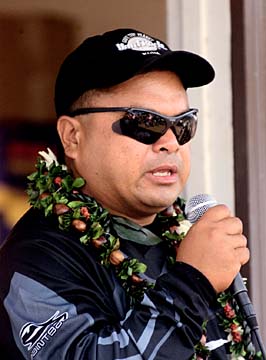
Benjamin Cayetano, delivering a speech, wearing leis

Benjamin Cayetano's climb to power is significant for the Filipino American community. His feat certainly makes holding a government office within reach for any aspiring Filipino American youths. It's not so far fetched to say that even the Office of President is within reach for Filipino Americans. (Especially so now that our current president is a member of a minority.) Cayetano's story makes it clear that it is possible to make a difference in society, even those from a poor background can rise up and take a stand. In fact, the school reform introduced by Cayetano was inspired by the hardships he faced in childhood. State funded after school programs would give students a place to be motivated and feel belonged.


Brandon, the son Benjamin worked to
support after high school, also in lei atire

Notably, Cayetano's beginnings are very relatable to many people both in the Filipino American community and outside. Working hard to support a new family with limited income is a daunting task, yet it is a situation that a lot of people find themselves in. Now, not everybody is going to become the governor of Hawaii, but Cayetano's story shows that there is more to be had and earned beyond working a dead-end job countless hours a week. So while Cayetano made significant headway for Filipino Americans by becoming the United States' first Filipino American governor, perhaps the inspiration he gives stems more from his humble beginnings than his great accomplishments.


Cayetano has written a memoir about his rise to power

-RZ

Monday, August 8, 1994

Kapamilya mo, Saan man sa mundo: Your Family, Worldwide

ABS CBN International: In The Service of The Filipino Worldwide

Alto Broadcasting System-Chronicle Broadcasting Network (ABS-CBN) is a multi-media conglomerate based on the Philippines. In 1994, ABS-CBN took their network to the international level and launched The Filipino Channel (TFC) on the West Coast in the United States. Shortly after launch, TFC became available nationwide and became the first and most successful Filipino broadcaster. Since then, it has become available in a number of countries world-wide with over 2 million subscribers. In the US there are 200,000 Filipino and Filipino-American subscribers alone.

The Filipino Channel has played a pivotal role in the Filipino community. There is probably not a single Filipino-American family that does not know about TFC. It continually provides one of the few places Filipino-American children can see role models of Filipino descent. ABS-CBN prides itself in being able to help second-generation and third-generation Filipino-Americans feel closer to the culture. The programs on The Filipino Channel include a variety of genres including comedies, dramas, reality shows and movies. It also provides a direct link to current events and news happening in the Philippines. One show, Citizen Pinoy, deals with issues regarding immigration and addresses various problems that might arise during immigration and settlement into the American lifestyle. Talk shows such as The Buzz keep Filipino-Americans up to date on the latest gossip regarding Filipino and Filipino-American celebrities. Balitang America was the first-ever Filipino American news program to be broadcast in the United States. Similar to other network news station, the stories reported on Balitang America feature community features, profiles, special reports, and international news.

TFC has developed its own shows that showcase and promote various Filipinos and Filipino-Americans world-wide. Wowowee is probably considered one of the most popular shows on The Filipino Channel. It is a variety show that often features Filipino and Filipino-American celebrities. It is normally filmed in the Philippines but has gone on tours in the past. This year, Wowowee went on a world-wide tour to celebrate its 4th anniversary. The show itself is comprised of a variety of segments. One is Hep,Hep, Hooray and involves 10 randomly chosen audience members. The audience dances to “Boom Tarat Tarat” while the 10 are chosen. The game itself requires coordination and rhythm with the last person standing becoming the winner. The participants then go on to play in several other segments. Some of the celebrity performances from the United States that have appeared on Wowowee have been the Jabbawockeez and Apl De Ap of the Black Eye Peas. The Philippines has also developed its own reality shows based on American shows such as The Spelling Bee and Pinoy Big Brother.

The services provided by ABS-CBN have expanded into other areas and includes many interactive venues. For instance, ABS-CBN now provides Filipino on Demand. This newest service is a video on demand subscription that gives access to award-winning classics, blockbusters, miniseries, and live concerts 24/7. TFC Studio Tours provides TFC subscribers with the chance to visit the studios and sit in on the shows. In addition, this is available world-wide depending on show availability. A number of the shows involve participation of Filipinos world-wide and aids in bridging the gap between the various countries Filipinos currently reside in.

-JP

Saturday, September 25, 1993

The Trials of Imelda Marcos

In 1993, Imelda Marcos, Former First Lady of the Philippines and widow of the controversial Ferdinand Marcos, was convicted of corruption on two charges by the Sandiganbayan (the anti-corruption court in the Philippines) and was sentenced to 18 years in prison and was barred from running for public office ever again. In total, more than 90 criminal and civil cases were brought against the Marcoses, with allegations that they stole more than $5 billion from the economy for themselves and even more for their associates.


Imelda being convicted

The Supreme Court would later overturn Marcos' prison sentence, ruling against the Sandiganbayan and accusing the Judge of having bias against Marcos. As of 2008, Mrs. Marcos still had 10 pending criminal cases. Over the years she has been able to use her political power to delay and overturn the cases brought against her and her husband. She has been able to avoid prison sentences, though the courts have seized some of her bank accounts.


Clip from the documentary, IMELDA, featuring a portion of her trials

How has this impacted Filipinos at home and abroad? The name Marcos is now equivalent to corruption in the Philippines as Nixon is in the United States, however on a much greater scale. Whereas Nixon only had one scandal tied to his name (Watergate), the Marcos have an entire era of martial law tied to theirs, during which they padded their pockets and led very lavish lives. However, unlike Nixon, who was pardoned by Ford, the Marcoses were exiled, and Imelda was charged for graft and corruption upon repatriating.

These trials are more symbolic than anything. They are a sign that Filipinos will stand up to corrupt politicians. At this point, I don't think it really matters if Imelda is convicted or not, as a practical matter. Would justice be served if she were to be convicted? Surely. Is it necessary? Probably not. The damage has already been done. Her name is already tarnished, and the history books will bear record of that. It doesn't really make sense to imprison her now; because of her age, any sentence would be equivalent to a life sentence, and is highly unlikely to happen because of that anyway. This is worth noting: although they won't sentence her now, they still won't overturn the remaining cases against her, because if anything, the show of the trials are symbolic of the Philippines' stand against government corruption.


This old lady wouldn't last a day in prison...

However, these trials may only be that: merely symbolic. There is still corruption in the Philippine government. Most notably, the current president, Gloria Arroyo, is accused by many of being corrupt. If Imelda's trials go on but not even a passing glance is pointed towards President Arroyo, then the trials won't mean anything but to pacify any dissenters while the nation's current politicians go on to exploit the country.


President Gloria Arroyo is believed by many to be corrupt

-RZ

Monday, July 16, 1990

1990 Luzon Earthquake


The late afternoon in Luzon was shattered by a 7.8 earthquake on Monday, July 16, 1990. Luzon, known for its dense population reported distinctly high deaths—numbering around 1,621 people. The 1990 Luzon earthquake is now known as one of the deadliest and consequently most expensive natural disasters to ever hit the Philippines.

About 20,000 square kilometers was damaged by this earthquake stretching from northwest of Manilla through Central Luzon and into the mountains of the Cordillera Administrative Region.

One of the hardest hit places was Baguio City. A popular tourist destination in the Philippines, many private and public building were damaged or destroyed. Many of these building were hotels. The most notable was the five-star Hyatt Hotel. A twelve story section above the lobby area collapsed, killing about fifty people.

Many of the people affected by the earthquakes, whether the Philippines was the place they were visiting or even worse, their homes were destroyed, set up tent in public parks, like Burnham Park, or in the streets. A major route from Manila is Baguio city, Kennon Road, was shut down by all the people living there.


Because of the placement of the city, it was impossible to send aid for the first forty eight hours. Water, communication, and electric lines were destroyed. Only by helicopter was aid able to get to the city, because it was surrounded by vicious landslides. The airport was demolished.

Hospitals crumbled literally and figuratively. The building could not be used and there were thousands of hurt people waiting to for medical attention. Hospitals set up tents. Baguio City became a tent city.

In the midst of this disaster, there were some miracles. Out of the Hyatt Terrace Hotel, two people came out alive days after the quake. Luisa Mallorca and Arnel Calabia were extricated from the rubble 11 days after the quake, while hotel cook Pedrito Dy was recovered alive 14 days following the earthquake. All three survived in part by drinking their own urine and in Dy's case, rainwater. Dy's 14-day ordeal was cited as a world record for entombment underneath rubble.

Because Baguio is home to a large mining company and a military academy, experienced miners and other disciplined volunteers played a crucial role in early rescue efforts. Rescue teams arriving from Manila and elsewhere in Luzon were able to decrease mortality from major injuries. Surgeons, anesthesiologists, and specialized equipment and supplies were brought to the area, and victims were promptly treated. Patients requiring specialized care (e.g., hemodialysis) not available in the disaster area were airlifted to tertiary hospitals in metropolitan Manila.

When we think of the recent Earthquake Ondoy, it is difficult to not remember what happened nineteen years ago.


-GY